


Landreth Gas Well
As drill testing for coal was their livelihood, two brothers, Stephen Albert and Enoch Landreth invested in a small hollow rod turn drill which they purchased from Peter Carmichael for $500. This was in 1905 and shortly after, they were joined in this enterprise by their brother, Joseph. Their first drilling was done on the Landreth farm. At 40 feet they found a 36 inch vein of coal. Enoch had been turning the power driven drill by hand which was often necessary, in order to assist in difficult cutting. This was strenuous work. Suddenly, he became ill and called to his brother, Joseph who told him to stand back, as he lighted a match. Imagine their surprise when ignited gas sent up and eight foot flame. Later Enoch attached thirty feet of pipe to the casing. The bright and continuous flame at this height was visible for quite a distance. It was estimated that there was sufficient gas to heat two dwellings. Naturally, the citizens of the Marceline vicinity were very excited about the discovery of gas and what its possible development could mean to the community. George Early, cashier of the First National Bank of Marceline, formed a company for the purpose of developing the gas well. Stock in the company was sold to citizens of the community at ten dollars per share. Although this project was discouraged by the Landreth family, 500 shares of stock were sold. The company employed Harve Stewart of Mendon and his helper, William Graves. Stewart owned a large drill and had just finished drilling an artesian well at Triplett. It required 23 wagons to move the derrick to the Landreth farm. When erected it stood at a height of 75 feet. At quite a depth, they encountered a large vein of fresh water; at 500 feet, a larger vein of salt water and at 800 feet, another vein of fresh water. Other veins of coal, also, were found but the water veins and the depth would have made it both difficult and unprofitable to mine the coal. For the first 40 of drilling, 12 inch pipe was used, then 10 inch pipe inside the 12 inch pipe to a depth of 940 feet and then six inch pipe inside the 10 inch pipe to a depth of 2,004 feet. This drilling was made through layers of ordinary soil slate, coal, fire clay, salt water, fresh water and solid rock. With no visible sign of ultimate success and company funds exhausted, the drilling finally stopped. In 1908, the derrick was dismantled and moved away. Still standing above ground today, is some of the pipe – the only tangible evidence of Marceline’s dream of a gas well.
McAllister Bros. Creamery & Bottling Works
Although liquidated ten years ago, the McAllister Creamery & Bottling Works, operating as “Marceline’s First Factory” from 1923 until 1953, played a significant role in the growth and development of Marceline. Any history of Marceline would be incomplete without proper mention of the McAllister firm, as well as the McAllister family itself, for the public esteem it held here and in surrounding areas for the varied and extensive services it rendered during the period it was in existence. The McAllister family entered Marceline’s business scene in 1891 when Bradford McAllister began his dray and express service with his sons. When the McAllister creamery closed in 1953, it employed 27 persons, 17 of which worked in the home plant in Marceline. It operated a fleet of 12 trucks to facilitate its extensive delivery service and used 25 tons of local freight from the Santa Fe Railway each month. It maintained branch offices in Carrollton, Chillicothe and Brookfield. Bradford McAllister, of Scotch-Irish descent, was born in Waldo County, Maine on August 6, 1846. Before moving to Carroll County, Missouri, at the age of 20, he had learned the trade of blacksmithing and carriage making. In 1869, he married Malinda J. Brown and to this union was born 12 children: Laura, Arthur, Fred, Emma, Louise, Ralph, Chester, Ross, John, Olive, Hazel and Earl. He farmed and operated a store in Carroll County before coming to Marceline in 1889. During the time Mr. McAllister operated his express business in Marceline, 1891 until 1912, he sold and delivered ice cut from nearby ponds. In the expansion of the retail ice trade from the McAllister pond, which served as a landmark in the northwest part of Marceline, the McAllisters then purchased Tam Carter’s hand-operated bottling equipment and building at the edge of the pond. Bottling was done by Ross McAllister at that location for one season. It then moved to the southeast corner of the McAllister block near the downtown district. Automatic bottling machines were installed as well as bottle sterilizing devices and the McAllister concern enjoyed an early reputation for purity and wholesomeness of quality for its bottled drinks, a reputation that was a part of their business until it closed and one that is readily recalled today by the countless number of customers it served at the time. In 1923, John W. McAllister purchased a small creamery and established it on the McAllister block. Shortly alter this new enterprise started, it proved successful and the father, Bradford McAllister, purchased a half interest in the plant from his son, John, and operating as B. McAllister & Sons, the firm gave employment to his other sons, Chester, Ralph and Ross. To assure supplies for their first rotary churn and creamery departments, a herd of cows was acquired and two large silos and a commodious bar were erected. As an example of the sturdiness of their buildings, the huge barn, with 4,000 square feet of floor space, is now standing northwest of the plant proper where it was erected almost forty years ago. The next McAllister enterprise was the making of ice cream. This was a natural step as they had access to a large quantity of natural ice, had the necessary dairy products and were experienced in the use of flavorings and extracts. The experimental equipment they first used for making ice cream was merely a modified and enlarged version of an old- fashioned hand freezer. This equipment was replaced with 75 gallon capacity boxes which contained 15 five-gallon cans surrounded by salted ice which had to be repacked twice daily. The ice cream department was under the personal supervision of Chester McAllister. The question of “the horse vs. the automobile” probably was dramatized no more obviously anywhere than in the McAllister organization. Their first experience with the horseless carriages was in 1914 when a one-ton Maxwell truck and Maxwell touring car were purchased from R. M. Wrenn. These early vehicles, which were none too dependable on the rough roads in the adjacent hill country, didn’t displace “Ole Dobbin’” from the service of this firm for several years. In 1918, Chester McAllister was elected mayor of Marceline, finishing W. C. Arnold’s unexpired term. He was then elected mayor at the next regular election and served until 1922 in that capacity. His administration of city affairs is recalled as highly successful and characterized by his policy of close economy with city finances. When the ammonia refrigeration equipment was installed in a special addition to the rear of B. McAllister & Sons’ plant, it not only offered a modern method of freezing ice cream, brine cooled and circulated between cans by machinery, but it provided also an excellent storage area for the 3,000 to 5,000 pounds of butter churned in the plant every week. “Goldenrod” butter, churned from high quality cream from farms of the Marceline area, was manufactured under the most sanitary conditions possible. The cream was pasteurized before it was churned to insure destruction of all harmful bacteria. Bradford McAllister later withdrew from the firm, B. McAllister & Sons and the name was changed to McAllister Bros., the name under which it was operating before the firm closed in 1953. In 1922, Ralph D. Crystal was sent to Brookfield to open a branch office and distributing point for McAllister products. The modern brick building with modern office, store rooms, cream-testing laboratory and mechanically-operated refrigeration storage was located north and across the street from the ticket office of the CB & Q, Burlington, Railroad. In 1933, Virgil Slaughter, a veteran McAllister employee, was sent to Chillicothe to open a branch distributing point there similar to the one in Brookfield. The Chillicothe branch was under the supervision of Ross McAllister who had operated the old bottling machine by hand in the early days of the company. During the same year, a service route was established out of the Marceline plant which distributed soda pop, ice cream, butter, candies and tobaccos to retailers in the towns and villages
Pischel
In 1949 R. Wallace Pischel of 728 East Gracia Street, Marceline, Missouri started a specialized printing business in his home. The business operated under his name and for the most part printed cookbooks. A year later he built a plant at 726 East Gracia Street and broadened his printing business to include high school yearbooks. The business flourished and in 1956 Mr. Pischel built a branch plant in Pasco, Washington, to accommodate the West Coast customers. In 1957 Mr. Pischel and his family moved to Pasco, Washington, leaving the Marceline printing plant to the management of Davie L. White and Robert C. Powell. In 1958 Mr. Pischel sold the Marceline plant to White and Powell who expanded the plant the following year by adding to the building and increasing the plant capacity by another printing press. Under the new management several publications have been added to the line which are distributed nationally by A. C. McClurg of Chicago, Illinois, and Art Emboss of Los Angeles, California. These publications are for the most part of the party and game and entertainment lines. The Wallace Pischel Yearbook publishers presently employ some fifteen personnel year around and at peak times employ as many as thirty people.
Cimarron Lumber & Supply Co.
Cimarron Lumber & Supply Company opened its Marceline branch in June 1956 in the McAllister Creamery Building, manufacturing aluminum storm sashes. In 1958, negotiations were completed for the purchase of the Service Pipeline Building. After extensive remodeling, the manufacturing of doors was added. In 1960, the move was completed and all operations were concentrated at the present locations.
Cater Opera House
The Cater Opera House was built by Dr. W. A. Cater in 1902 and was formally opened in October. In the early days, stock companies appeared here for one-week stands, with a change of program every night. The Mayhall Stock Company of Goren, Missouri, which played here many seasons, was one of the favorites. The Dubinsky Brothers Stock Company was another troop which made regular visits to the Cater Opera House. Marjorie Rambeau, who later became a well-known film actress, appeared here in stock companies. Around 1910, the Opera House was changed into a picture show by Dr. Roy and Don Cater, and, with the addition of a balcony, seated about 600. Among the early managers of the theater were Jack Lovely, Ned Howe, and Carl Bon. That was in the days of 5 and 10 cent picture shows, and among the favorite stars were Maurice Costello, Theda Bara, Mary Pickford, John Bunny, Charlie Chaplin, Fatty Arbuckle, and Marie Dressier. A three-piece orchestra was used and it was Jimmie Julian, who as trap drummer, created all of the sound effects incidental to the picture. Edward Baxter was the violinist and Chelsea Parks Love was the accompanist. Others who played the piano were Beulah Reece Hunter, Ida Laird Taupert, Elizabeth Early Reed, and Ethelyn Howe. The Opera House was also the scene of many hotly contested athletic events. There were many fights and wrestling matches held there. Walt Posey and Bood Ellis were the promoters. Some of the fighters were Ralph Faulkner, Frankie Dean, Edgar Myers, Jewell Wade. Fred Doyle, Glen Lancaster, and Newell Whitney were referees of many of the fights. Among the wrestlers were William Marts, Billy Brown, Lon Owens, S. R. Tippett, Dan Hunter, and Curtis Hicks. The Opera House was also the scene of many important dances. The Firemen’s Ball and the B. of R. T. Ball were always held there, also both private and public dances. Toots Gates was official caller for the square dances. Before there ‘was a school auditorium, the school plays and graduating exercises were held at the Opera House. When the Disneys were here in 1956, Roy Disney said that the Opera House was where he made his first attempt at acting in a high school play. Many musical comedies were given there, using home talent, with a coach from out of town. The Cater Opera House was the center of activity for all major entertainment. After the Uptown Theater was built, the picture show closed in the Opera House. When the stage was torn down in order to enlarge the dance floor, two of the scenic curtains were sent to Knotts Berry Farm in Southern California where they were to be used in an old time Opera House that Mr. Knott expected to add to his already famous “Ghost Town.” The last 25 years, the hall was used mainly for Saturday night dances with William Marts, Pete Riley, and Steve Chiolerio the main managers. With the fire which occurred on a Saturday afternoon, January 26, 1957, the old Cater Opera House is now only a happy memory.
Marceline State Bank
The charter of the Marceline State Bank was issued December 23, 1907, by Hon. John E. Swanger, Secretary of State of Missouri. The capital stock was $20,000. A building was erected and opened for business at 107 North Kansas Avenue, where Reece’s confectionery was located. In May 1909, the present building was purchased. The new bank front and improvements of the Howell Street side wall were made in 1930-31. The original shareholders and temporary directors were W. C. Hume and five men who were non-residents. W. C. Hume was the first cashier and served until 1913. J. A. Neal served as cashier from 1913 to 1928 except the years 1917-18. In January 1917, a large interest was purchased by Dan Wester of Kansas City and he was elected cashier. In January, 1919, the Wester interest was purchased by J. A. Hamler and associates, and Mr. Hamler was elected president. On April 27, 1922, the interest of J. A. Hamler was purchased by H. E. Trader and associates, and Mr. Trader was elected president, a position he held until his death in November, 1960. In October 1938, E. B. Moorman, replacing J. A. Neal, came to the bank after completing a course at the Gem City Business College. Through the years Mr. Moorman served as Assistant Cashier, Cashier and Vice-President. In November 1960, Mr. Moorman purchased controlling interest from the estate of H. E. Trader, was elected President, and still holds that position. The present board of directors are E. B. Moorman, Agnes B. Trader, George R. Lohmar, Dorothy H. Moorman, and Alys M. Culler. The bank is well appointed, occupying a modern building at the corner of Howell and Kansas Avenues. The interior of the building was thoroughly remodeled and completed in 1961. The interior is handsomely furnished and artistically decorated with walnut paneling, terrazzo floor, acoustical ceiling with indirect lighting and is equipped with the most modern fixtures and equipment. The Marceline Trust Company began business in 1920. In May 1924, its business was taken over by the Marceline State Bank and the First National Bank, each bank purchasing one-half of the assets and assuming one-half of the deposits. Its depositors were thus paid in full. In the dark days of November 1931, the bank’s remaining contemporary was closed. An immediate organization movement of business men and citizens, and the fine cooperation of the State Bank’s city correspondents enabled the bank to withstand the shock without trouble. Instead of having a “run” as occurred in many similar cases, the bank made a good gain in deposits in three days’ time, and continued gaining. At the close of the ten-day National Banking Holiday, ordered by the President of the United States in March 1933, the bank was permitted to open for business without restrictions. Since then its business has grown steadily. The bank now has total deposits $3,008,000.
Reece’s Confectionery
Edgar Reece started the business some years before his marriage to Allie Williams in 1912. At that time the firm was located at 108 South Kansas Avenue. The business was destroyed by fire in 1928 and it was about six months before the Reeces’ opened up again in the present location of 107 North Kansas Avenue. Mr. Reece died in 1930 but Mrs. Reece and her daughter, Ernestine, continued to operate the concern together until June 1957, when another change took place with the marriage of her daughter to Jean Hirsch and the couple left Marceline to reside in Texas. Mrs. Reece continued to operate alone until the confectionery was sold in 1960 to Mrs. Della Lake. In Marceline, Reece’s has been considered by patrons here and in towns surrounding the area as “the place to go” for good wholesome refreshments and sandwiches. One merchant in Marceline of many years said, ”In my early days when a young man walked his date for a treat at Reece’s, it really made an impression and it would be interesting to know how many successful marriages culminated by couples whose future plans took form while on dates at Reece’s.” Mrs. Reece is a native of Marceline and graduated from the Park High School in 1909. Her first employment was with a local newspaper, The Marceline Mirror, then owned by J. D. Mendenhall. Afterwards she worked as a clerk at the Marceline Post Office for about two years until her marriage. She has one sister, Mrs. Lillian Shannon, Kansas City, Kansas.
St. Francis Hospital
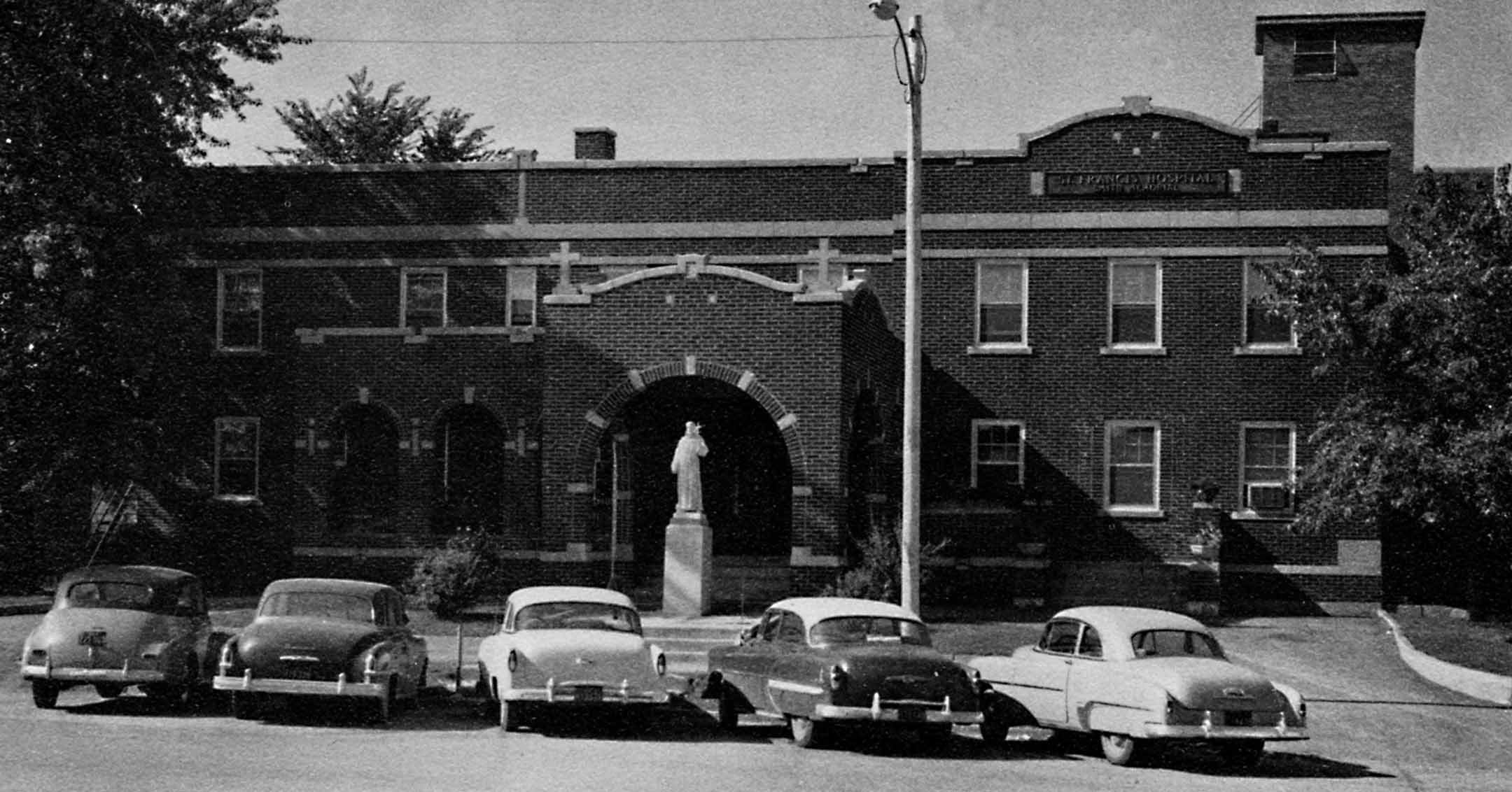
EARLY HISTORY St. Francis Hospital as it is known today, originated as a ten-bed structure built in 1923 by Floyd Neiman, Marceline Contractor, for Ola Putman. M. D., as a memorial to his father, Benjamin S. Putman, M. D., who had served the Marceline area forty-seven years as physician and surgeon. He called it the “Putman Memorial Hospital“. It is situated at 108 East Howell Street. Dr. Benjamin B. Putman was a member of one of the oldest families of Linn County and was born in North Salem township of that county June 10, 1844. He had a rural environment during his youth, and had begun the study of medicine during the Civil War. He read medicine in the office of a practicing physician, Dr. D. I. Stevenson, and in 1864 took a course of lectures in the St. Louis Medical College. With this preparation he entered upon a country practice, and in 1872 returned to the St. Louis Medical College, where he was graduated with the degree of M. D. He first practiced at North Salem, and for 28 years made his home at Bucklin. During twenty years of that time he conducted a drug business in connection with his practice. Doctor Putman in 1889 established his home at Marceline, and during the nearly 20 years that remained to him, he worked with seldom a vacation or interruption to his continuous service covering a wide extent of country around Marceline. On locating at Marceline, he became local surgeon for the Santa Fe Railway, and during the last fifteen years of his life, looked after the surgical practice of coal mining companies in that vicinity. The work of his profession was to him a primary responsibility and a great duty which he performed unremittingly and with little concern for its material rewards. He was a member of the Missouri State and District Medical societies, served at one time as mayor of Marceline, was a Democrat and a 32nd degree Mason. He was active until his death in 1912, at the age of 69. Dr. Ola Putman, builder of the Putman Memorial Hospital, and father of Dr. George Benjamin Putman, was born at Bucklin, June 6, 1878. He received his early schooling at Bucklin, then because of poor health went to Colorado and attended the Denver University and Gross Medical College. He was a graduate of Rush Medical College in Chicago in the class of 1901, and practiced at Marceline from 1901 until his death on December 4, 1933, a period of over thirty years. He was surgeon of the Santa Fe Railroad for thirty years, was Sigma Alpha Epsilon, a member of the County, State and American Medical Associations. He was one of the most advanced of the early surgeons of Missouri and attracted nationwide attention. He was one of the first surgeons west of the Mississippi to perform a Caesarian operation. He was a pioneer in the treatment of hay fever and asthma, from which he was a great sufferer. He discovered and isolated the first case of tularemia in Missouri. He was associated with his father until the latter’s death in 1913. In 1923 he built the 10-bed hospital as a memorial to his father and was its active head during the last ten years of his life. Dr. George Benjamin Putman represented the third consecutive generation in his profession at Marceline. He was born at Marceline July 22,1907. After graduating from high school in 1925, he took two years of medicine at the University of Missouri, was awarded his A. B. degree by Harvard University in 1929, and in 1933 was graduated in medicine at the Cornell University Medical College in New York City. Doctor Putman had experience as an intern at Jersey City Medical Center, and in 1934 returned to Marceline to take over the work in which his father and grandfather before him had earned deserving distinction. He was a member of the Linn County, Missouri State, and American Medical Associations. He took over his father’s practice in 1933 upon the latter’s death and continued to care for the people of the Marceline area until an untimely and sudden accident abruptly ended his medical career. On the night of February 22, 1942, he was driving through a snowstorm to attend a maternity case when he had a motor car accident and sustained severe contusions, concussions and laceration of the brain. He has been hospitalized since. The Putman Memorial Hospital continued operation under two local doctors for a couple of months after Dr. Putman’s accident but was finally closed on May 1, 1942, and remained unused until April of 1946. Mrs. Ben (Mildred) Putman sold it to two elderly ladies of Keytesville, Missouri, Mrs. James (Elizabeth) Robertson and Mrs. Robert (Mary) Guthrie. These two ladies purchased the building for $20,000 then deeded it over to the Sisters of St. Francis whose Motherhouse at that time was in Chillicothe, Missouri, in memory of their two brothers, J. Hudson Smith and William Smith. Arrangements for the transaction were instituted by the Rt. Rev. Thomas J. McCartan, then pastor of St. Bonaventure Church, Marceline, Missouri. St. Francis Hospital was not ready to serve the public immediately. Months of remodeling, repairing, and renovating were required before the building was in shape. New equipment was installed and the hospital space utilized in a manner to enable the Sisters to care for sixteen patients. The Hospital was re-opened on August 15, 1946, and dedicated formally on October 6, 1946, with the late Bishop C. H. LeBlond of St. Joseph, Missouri, as the principal speaker. In a perfect Indian summer setting the St. Francis Hospital was dedicated “to the service of humanity.” Bishop LeBlond told the large gathering present: “With all the efforts of the United States directed for five long years to war, to the destruction of human life and property, the dedication of an institution for unselfish service to the community of Marceline has marked the beginning of a new
Robert W. Smith, M.D., Chief of Staff
Robert W. Smith, M.D., was born in Washington, Iowa on November 5, 1918. He was graduated from Central Missouri State College in 1939 with AB and BS Degrees. In 1941 he was graduated from the University of Missouri with a BS in Medicine and in 1943 from the St. Louis University School of Medicine. He interned at St. Mary’s Hospital in Kansas City, Missouri, in 1943, after which he served a year as a resident in surgery in the same hospital. For the next , two years he was assistant chief of Surgery of the 147th General Hospital at Scolfield Barracks. Dr. Smith attended the Cook County Postgraduate School of Medicine in Chicago in 1958 and was accepted as a fellow in the International College of Surgeons in 1959. In 1962 he was accepted as a member of the American Society of Abdominal Surgeons. He is a staff member of St. Mary’s Hospital in Kansas City and of Pershing Memorial and is a member of the American Medical Association, the Missouri State Medical Association, Jackson County Medical Society, Grand River Medical Society, Association of Railway Surgeons, and Missouri State Surgical Society.
P. T. A.
The P. T. A. held their reorganizational meeting March 24, 1960 in the school lunchroom. Mrs. W.T. Tomlin, District president of the Missouri P.T.A., was the guest speaker. Rev. Neil Dubach was the first president of this organization. The by-laws were adopted in May. The P. T. A. has been active in school programs and in the annual Unicef Drive. The following have served as president of the P. T. A.: Neil Dubach, 1960; Mrs. Harold Minor, 1961; Marsh Dorrell, 1962-1963.